

*Though it only features screenshots from Dosage Calc 360, the information in this article applies to all Davis 360 platforms, including Dosage Calc 360, Med Term 360, and Test Success 360.
*This guide is intended for instructors using LMS course shells that have been prepared by an admin, or by instructors who have already inserted Davis 360 class links themselves. If an admin has not inserted Davis 360 class links into your LMS course shell, or if you haven't been provided a copy of an LMS course shell with inserted Davis 360 class links, please contact [email protected] for further assistance.
1. Before you begin
If an admin has set up your integrated Davis 360 class and inserted a class link into your LMS course, do not log into the Davis 360 website and create a Davis 360 class manually, because doing so will create a second Davis 360 class that will not be integrated with your LMS course.
Though your integrated Davis 360 class has already been created, there are class settings you may still need to finalize prior to the start of your semester. To begin, log into your Learning Management System (Blackboard, Canvas, Moodle, or D2L/Brightspace) and access your course.
2. Locate a Davis 360 class link
Once logged into your LMS course, locate a link to your integrated Davis 360 class.
The locations and titles of Davis 360 class links will vary depending on how your admin has designed your course. Look for names like "Dosage Calc 360," or the title of your assigned Davis 360 platform. Ask your admin for help if you're unable to find your Davis 360 class links.
Though the example below is of a Dosage Calc 360 class link within a Canvas course, your Davis 360 class links will appear similarly in all Learning Management Systems:

For more information about the assignment types offered by your Davis 360 platform, alongside information on implementing Davis 360 within your syllabus and lesson plans, please consult our Instructor "Assignment Types" article.
3. Launch a Davis 360 class link
Click the link in your LMS course to launch a Davis 360 class. Depending on your LMS, the Davis 360 class link may load automatically in a new browser window, or you may be taken to a launch page with a button to load the class.
If you are taken to a Davis 360 class link launch page, you may see an assignment description entered by an admin. If you don't see an assignment description, you can add one later on the assignment's setting page in your LMS. Click the button that reads "Load (link title) in a new window," so your class link will launch in a new tab.
If you click a Davis 360 class link and it fails to launch, it's possible your web browser settings blocked the class' launch page. Check your browser settings to make sure pop-ups are permitted.

After launching a Davis 360 class link, you'll be taken to the Classes page for your associated Davis 360 platform.
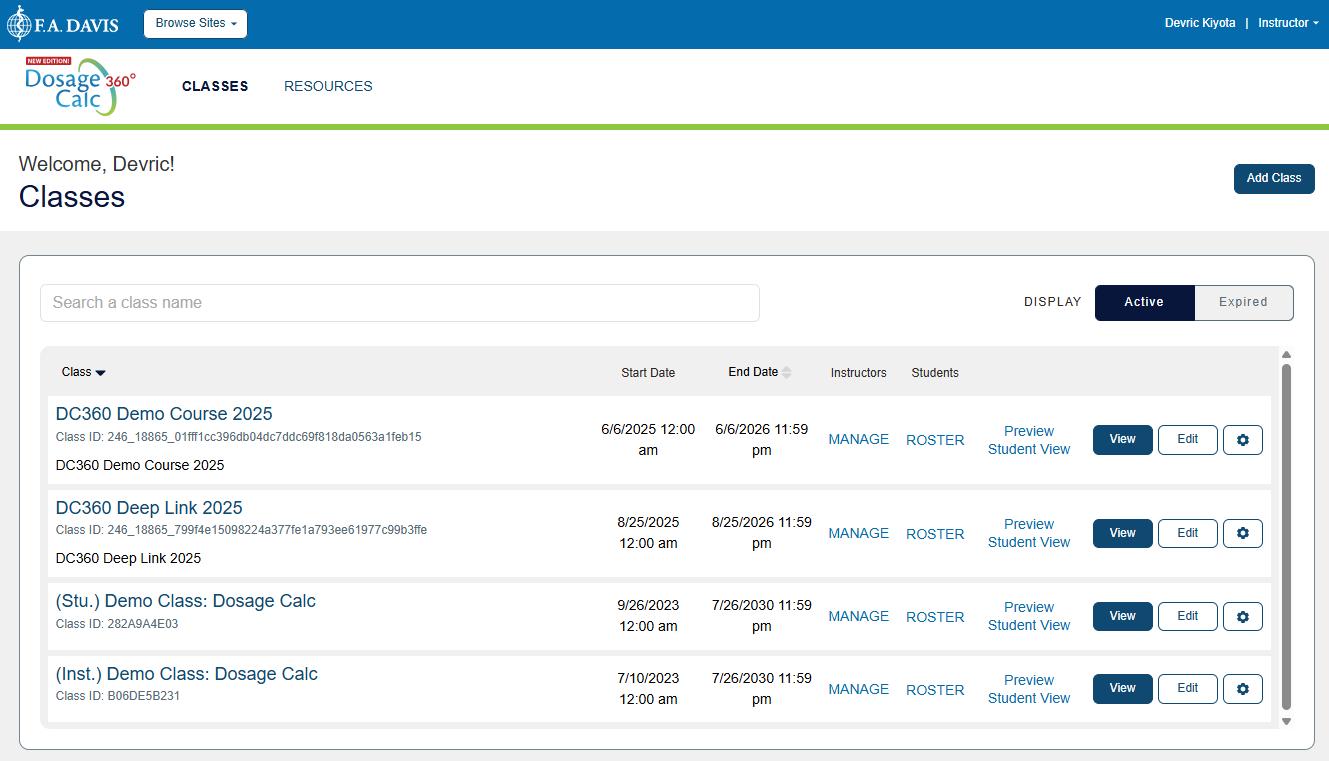
Alternatively, if your FADavis.com account has access to multiple Davis 360 platforms and/or Davis 360 classes, launching a Davis 360 class link will first take you to your Davis 360 My Products page, wherein you'll choose the correct edition of the Davis 360 platform associated with your LMS course.
On your Davis 360 My Products page, click the "Launch" button for your platform to access its Classes page.
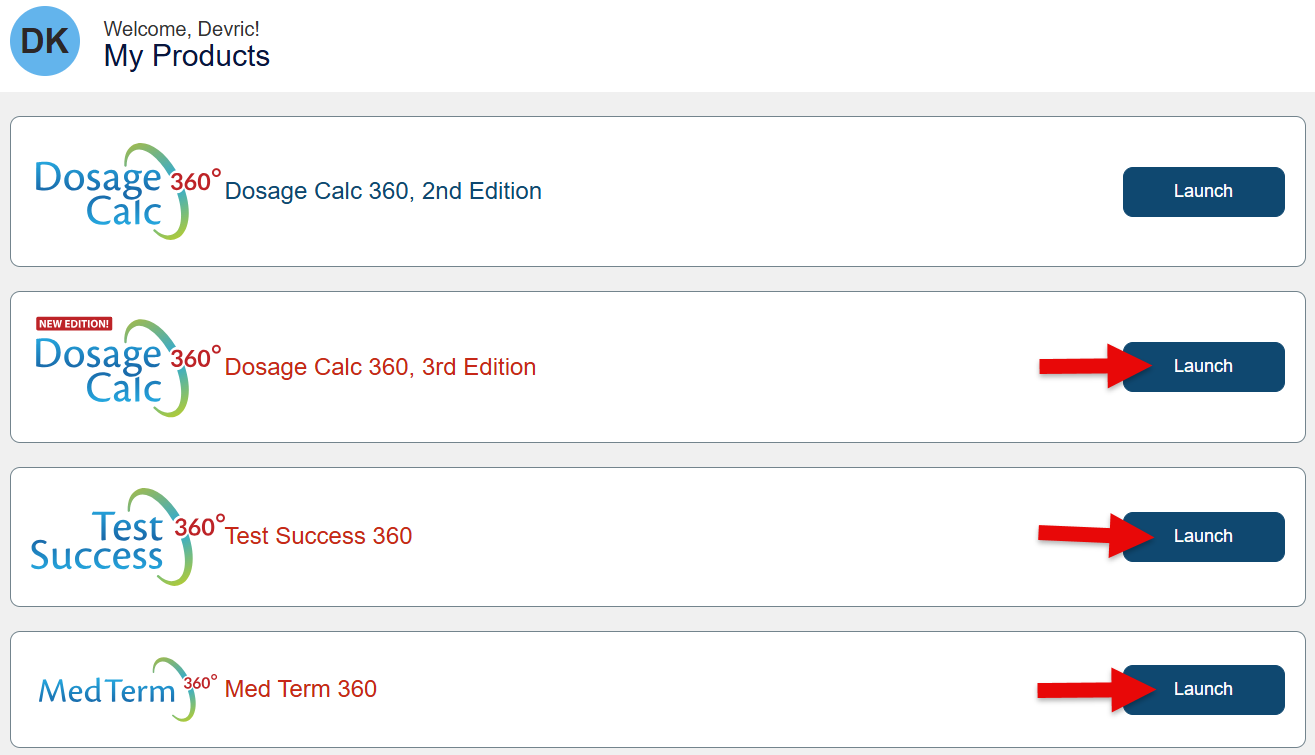
If your Davis 360 class link launches successfully (to either your Davis 360 My Products or Davis 360 platform's Classes page), that means your integrated Davis 360 class link is functional. Your students will now be able to use a class link in your LMS course to automatically enroll in this integrated Davis 360 class and access their assigned coursework.
Please stress to your students that they can always access their Davis 360 class and assignments by launching the links in your LMS course.
4. Navigate to your Davis 360 Class Setup
If your admin wants you to finalize your Davis 360 class settings and set due dates within Davis 360, first launch and/or navigate to your Davis 360 platform's Classes page.
Your Davis 360 platform's Classes page collects your current and expired Davis 360 classes. You may see a duplicate listing directly below your integrated Davis 360 class, but you can disregard this as a normal part of the integration display. Please only make changes to the class atop its duplicate.
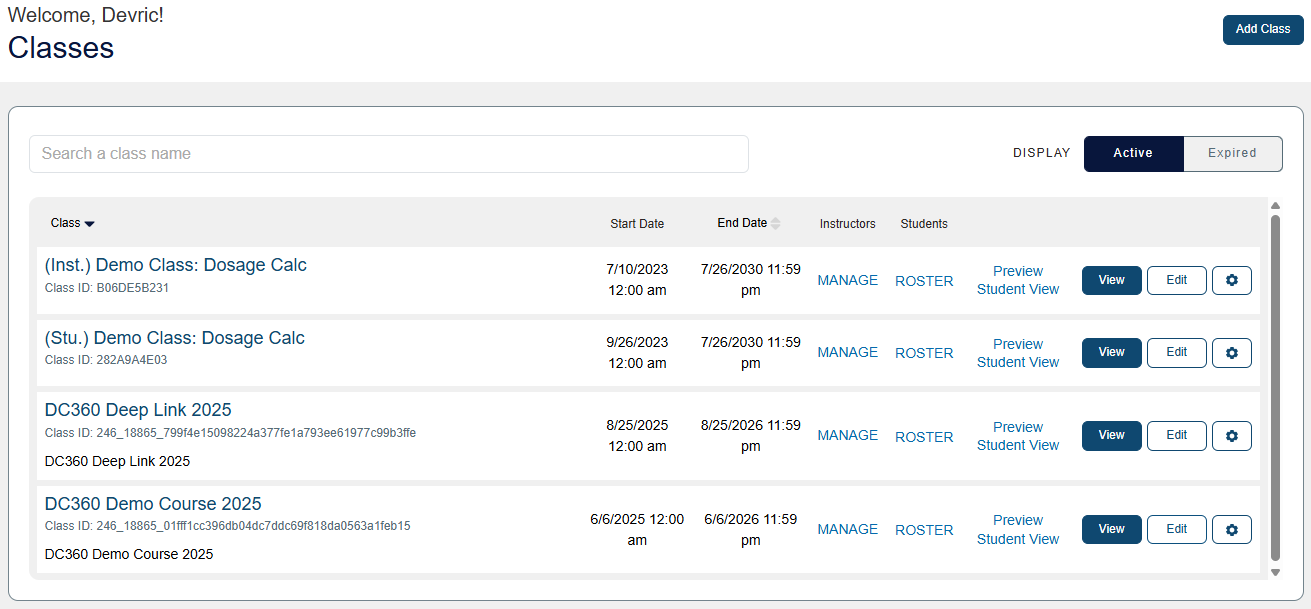
Click "MANAGE" (1) if you have a co-instructor who needs access to your Davis 360 class. For more information on adding co-instructors to your Davis 360 class, consult our "Adding Co-Instructors" article.
Clicking "ROSTER" (2) will bring you to your Davis 360 class' student roster, so you can confirm all your students have enrolled.
To get a look at your Davis 360 class from the student-side and work through assignments as if you were a student, click "Preview Student View" (3).

Clicking the cog button on the right side of each class listing will open a dropdown menu with three options: “Copy Class ID,” “Clone,” and “Delete.” You won't need to copy your Class ID, because students will be automatically enrolled in your Davis 360 class when they launch a class link via your LMS course.
In future semesters, you may utilize the "Clone" feature to copy your Davis 360 class, though simply copying your Davis 360 here will not integrate the copy with a new LMS course. For more information on copying integrated Davis 360 classes, please consult our "Copying Classes" article.
Even after your class has concluded, please don't delete integrated Davis 360 classes, because doing so can cause technical errors for your LMS course and later cloned Davis 360 classes.

To view a class' Dashboard, click its "View” button. From a class' Dashboard, you'll be able to navigate to the class' Gradebook and other resources.
Click an "Edit" button to access your Davis 360 Class Set-up, so you can progress toward finalizing your Davis 360 class' settings.

5. Finalize your Davis 360 Class Setup
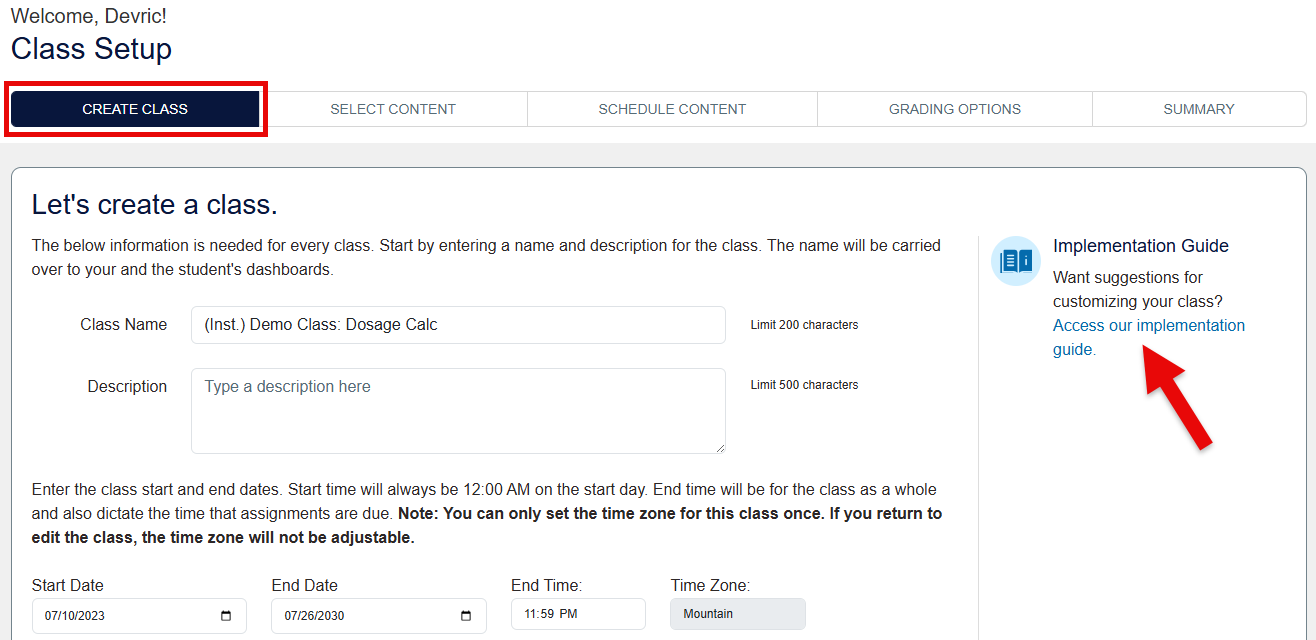
On the Class Setup page, you will see a menu with five steps of adjustable course settings. If you're editing a Davis 360 class that was set up for you by an admin, some of these steps will have already been configured for you.
The first step, "Create Class" will primarily require you to confirm the macroscopic details of your Davis 360 class, such as class name, the duration of the class via its Start and End Dates, and your time zone. We recommend giving your integrated Davis 360 class the same name as the LMS course it's paired with, to increase student recognition.
If you encounter a setting on the "Create Class" step, or any other step of the Class Setup, that you need to change and are unable to do so, please contact us via [email protected] so we can assist you.
On the right margin of your "Create Class" step, you'll see a link to load your Implementation Guide, which will give you more insights on how to implement Davis 360 assignments within your syllabus.
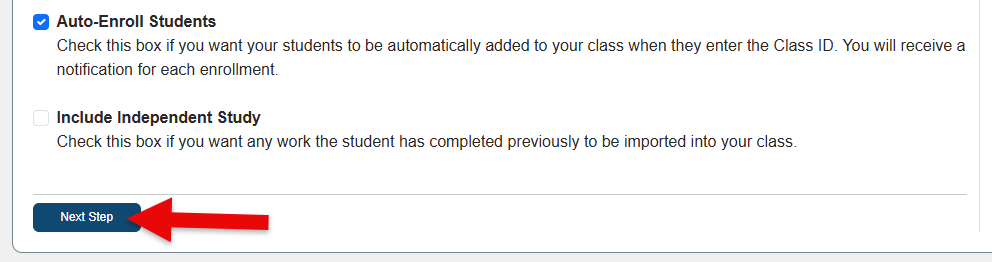
At the bottom of the "Create Class" step, please leave the "Auto-Enroll Students" checkbox checked, so your students will be enrolled when they launch a Davis 360 class link inserted into your LMS course.
Clicking the "Next Step" button saves whatever changes you made on a step of the Class Setup, in addition to progressing to the next step of the Setup.
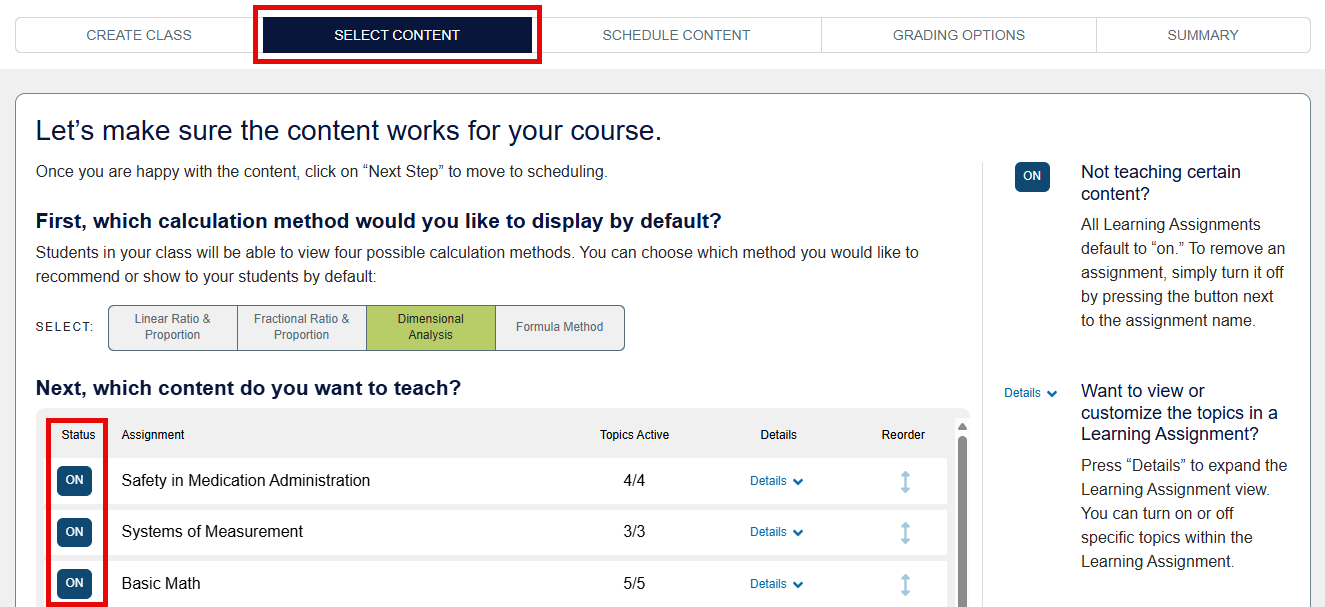
On the "Select Content" step, you'll see a list of all the premade Davis 360 assignment modules available within your Davis 360 platform. This is where you can finalize the types of content and the number of exercises available to your students within each assignment module.
Please verify the topics turned ON here match the topics you'll cover in your syllabus. If you will not cover a topic listed on this step, please turn it OFF, so your students will only see Davis 360 assignments that align with what they expect to cover in-class.
When setting up a Dosage Calc 360 class, you'll additionally need to choose which calculation method students will be shown by default.
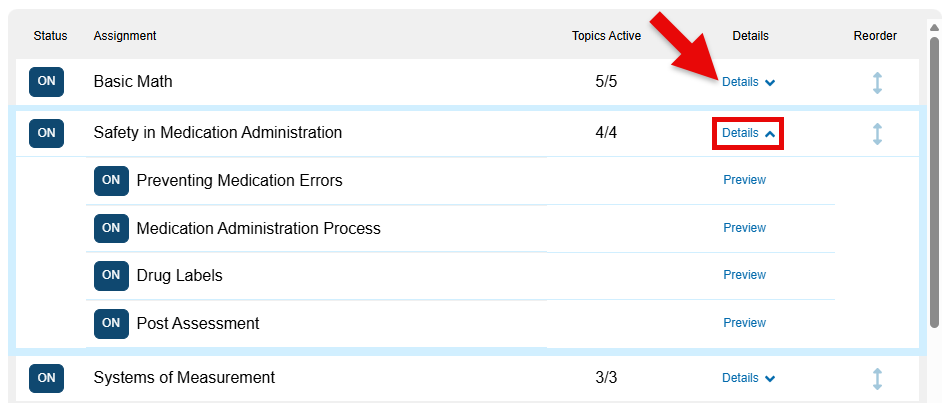
You can preview or turn off content in Davis 360 assignment modules down to the exercise level. Click its "Details" button to open the full contents of a Davis 360 assignment module.
Before students begin working in your Davis 360 class, please make sure you or an admin have finalized which exercises your students will be responsible for completing. To learn more about the different types of exercises within Davis 360 assignments, please consult our student "Assignment Types" article.
When you are finished making changes, select “Next Step” to move on.
The "Schedule Content" step of your Davis 360 Class Setup is where you'll finalize due dates for your Davis 360 assignments. If you want students to be penalized for late work in your course, you will need to enter assignment due dates on this step.
Select “Set dates,” then scroll down to see a list of assignments available in your course.
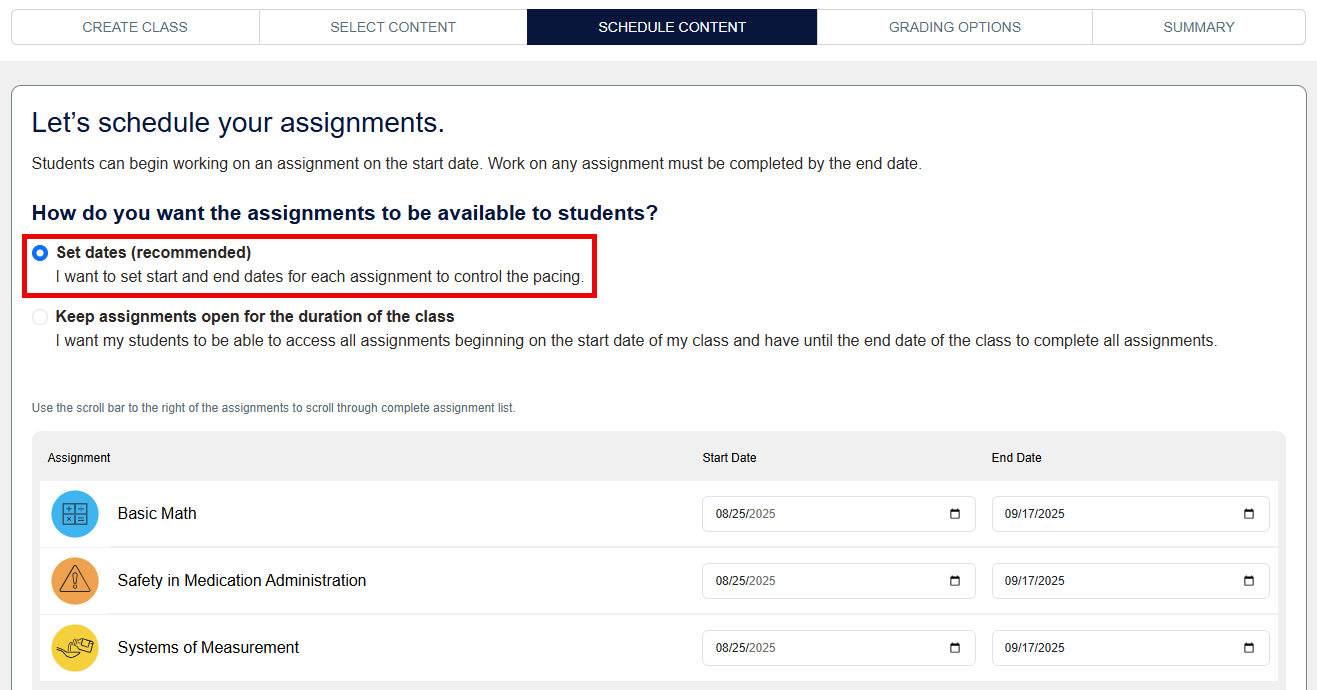
For each assignment, you will see a Start Date and an End Date. Most instructors forgo setting Start Dates, giving students have the opportunity to work ahead and/or preview the content in upcoming topics.
With each End Date, select your intended due date for that assignment. The student will still be able to access assignments after their End Dates, but any new work submitted will be flagged as late and assigned a pending grade of “0” to override at your discretion.
For more information on late work, please see the “Davis 360 Gradebook Features” section of our instructor "Grading and Metrics” article.
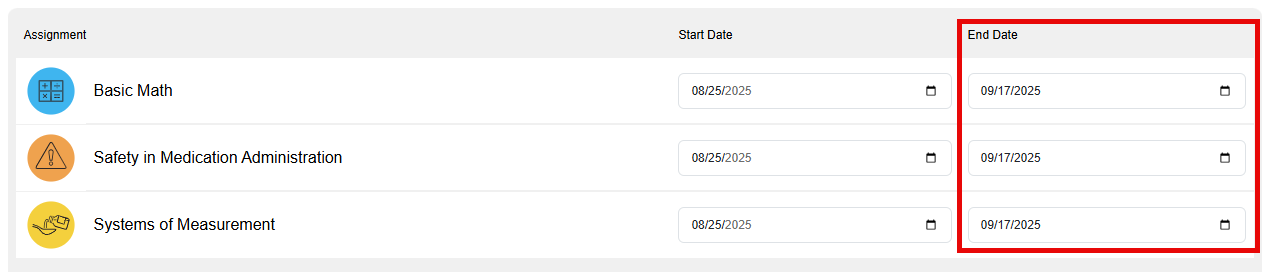
When you are finished selecting your due dates, click “Next Step” to save your changed due dates and move on.
On the "Grading Options" step of your Davis 360 Class Setup, you can choose grading rules for different Davis 360 assignment types. Please note that grading rules should be selected before students enroll and begin working in your course.
Information about each grading rule can be found on the right-hand side of this step. More information on grading can also be found in our "Grading and Metrics" article for instructors.
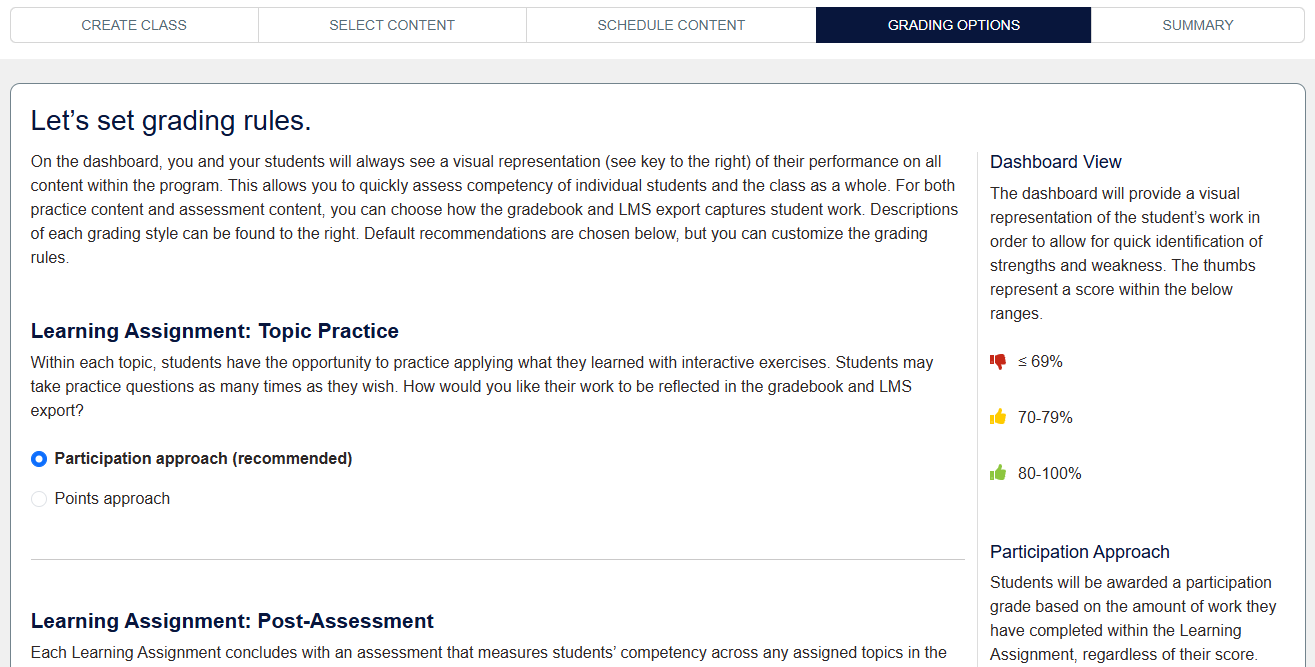
The majority of your graded Davis 360 content will be pre-made assignment modules, comprised of Subtopic Practice exercises and a Post-Assessment within those respective assignment modules.
Subtopic Practice exercises are graded based on completion. We recommend leaving these assignments on the default "Percentage-based Participation Grade" selection.
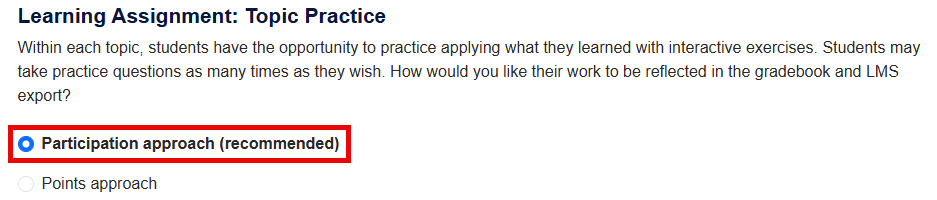
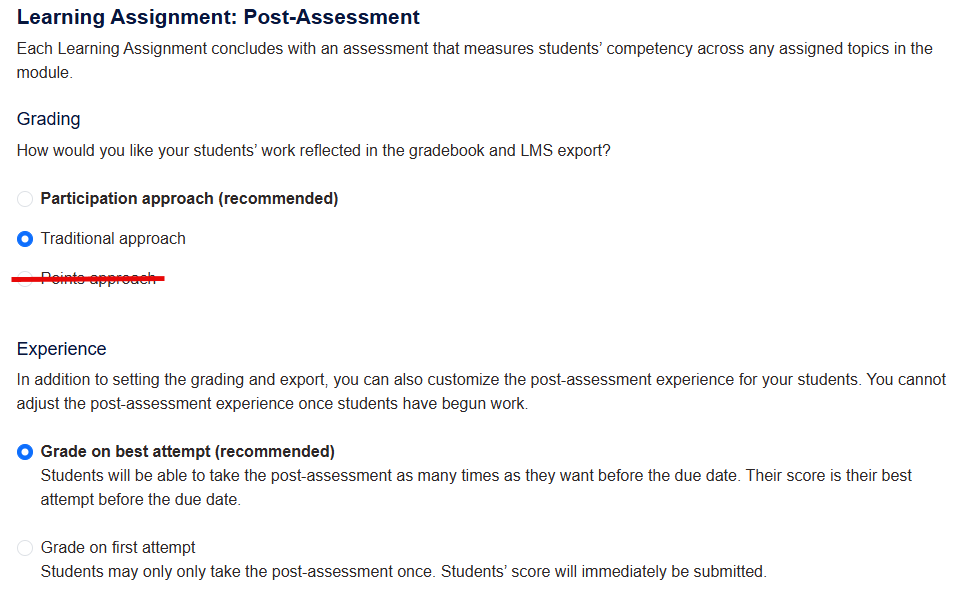
The Post Assessments that conclude each of your Davis 360 assignment modules can be graded based on completion or competency. Here, the "Participation approach" selection will grade students based on completion, whereas the "Traditional Grade" selection will grade students based on how many quiz questions they get correct.
We do not recommend selecting "Points approach."
Additionally, Post-Assessments can be graded based on a student's best or first attempt. If graded on their best attempt, students will be allowed to retake Post Assessments, with only their best score recorded in your Davis 360 Gradebook. If graded on first attempt, a student's first score on a Post Assessment will be the only score recorded.
Though the Class Setup defaults to and recommends the Participation approach and "Grade on best attempt," our team generally recommends choosing Traditional approach and "Grade on first attempt" for Post-Assessments, to guide students toward completing Post-Assessments thoughtfully.
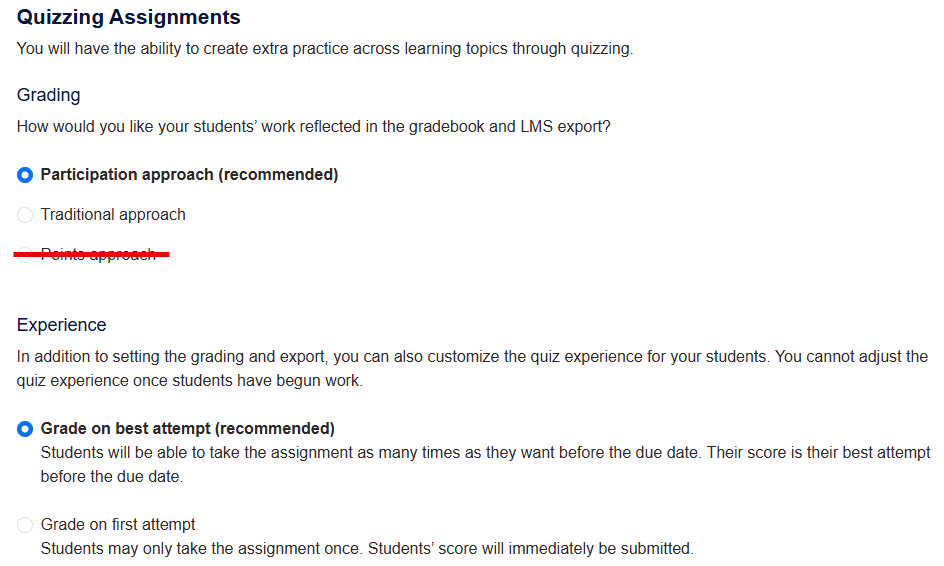
Just like the Post Assessments, you can choose to grade Quizzing Assignments based on completion or competency. Choose "Participation approach" to grade based on completion, or "Traditional Grade" to grade students based on how many quiz questions they get correct.
Again, please do not select "Points approach."
Then, select whether you want Quizzing Assignments to be graded on best attempt or first attempt.
Similar to Post-Assessments, our team recommends the Traditional approach and "Grade on first attempt" for Quizzing Assignments.
Click "Next Step" once you've decided how your Davis 360 assignments will be graded.
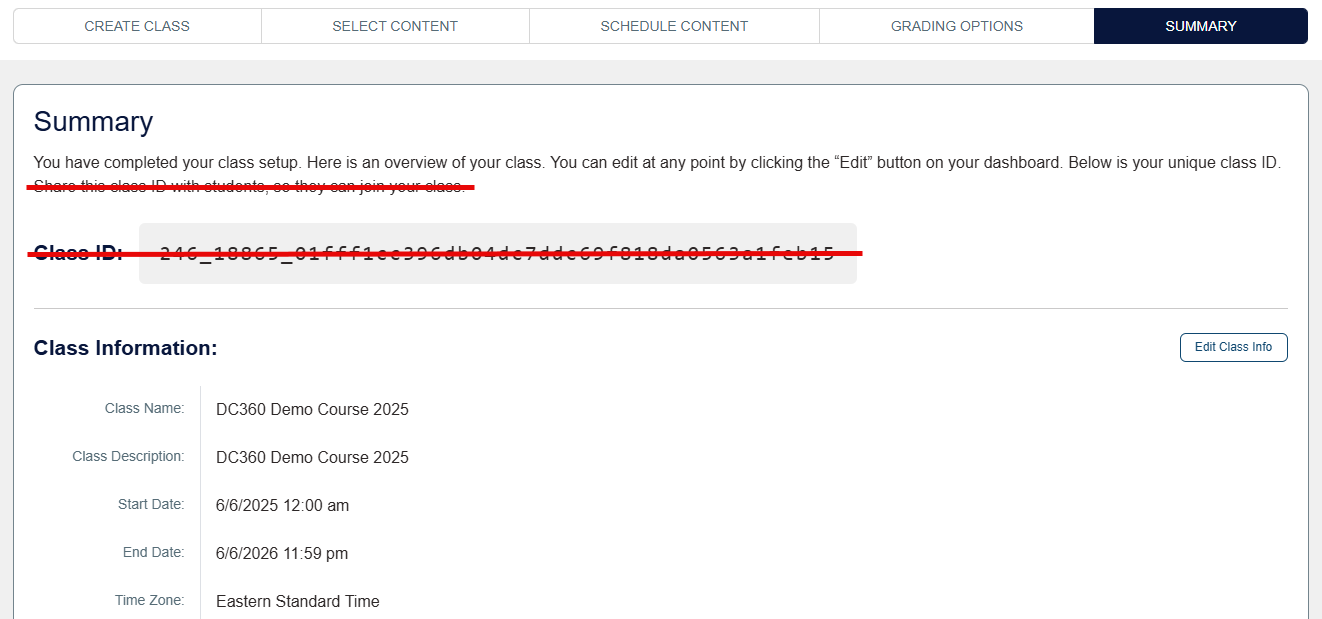
The "Summary" step of your Davis 360 Class Setup allows you to review the settings choices you've made.
Though it instructs you to do so at the top of the "Summary" step, you won't need to share your Class ID with your students. Because your Davis 360 class is integrated within your LMS course, your students will automatically enroll in your Davis 360 class by launching Davis 360 class links via your LMS course.
6. Check student performance
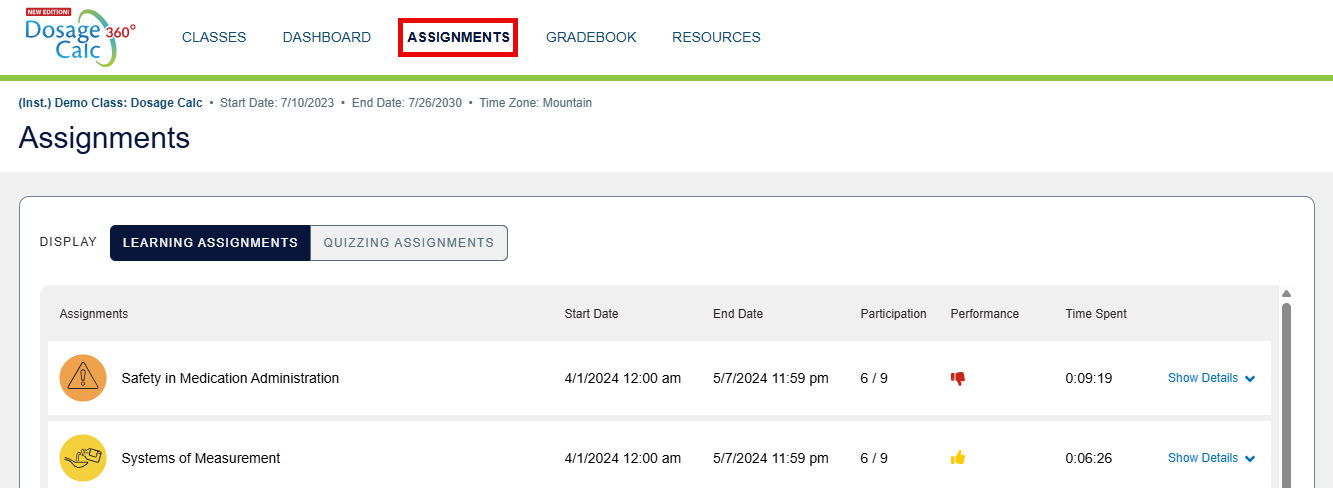
As students complete Davis 360 assignments, their scores will be saved and viewable on your Assignments and Gradebook pages.
To see how well your students are doing on your Davis 360 assignments, navigate to your Assignments page. For more information on the student performance data offered by your Assignments page, please consult the "Actionable Analytics" section of our "Grading and Metrics" article for instructors.
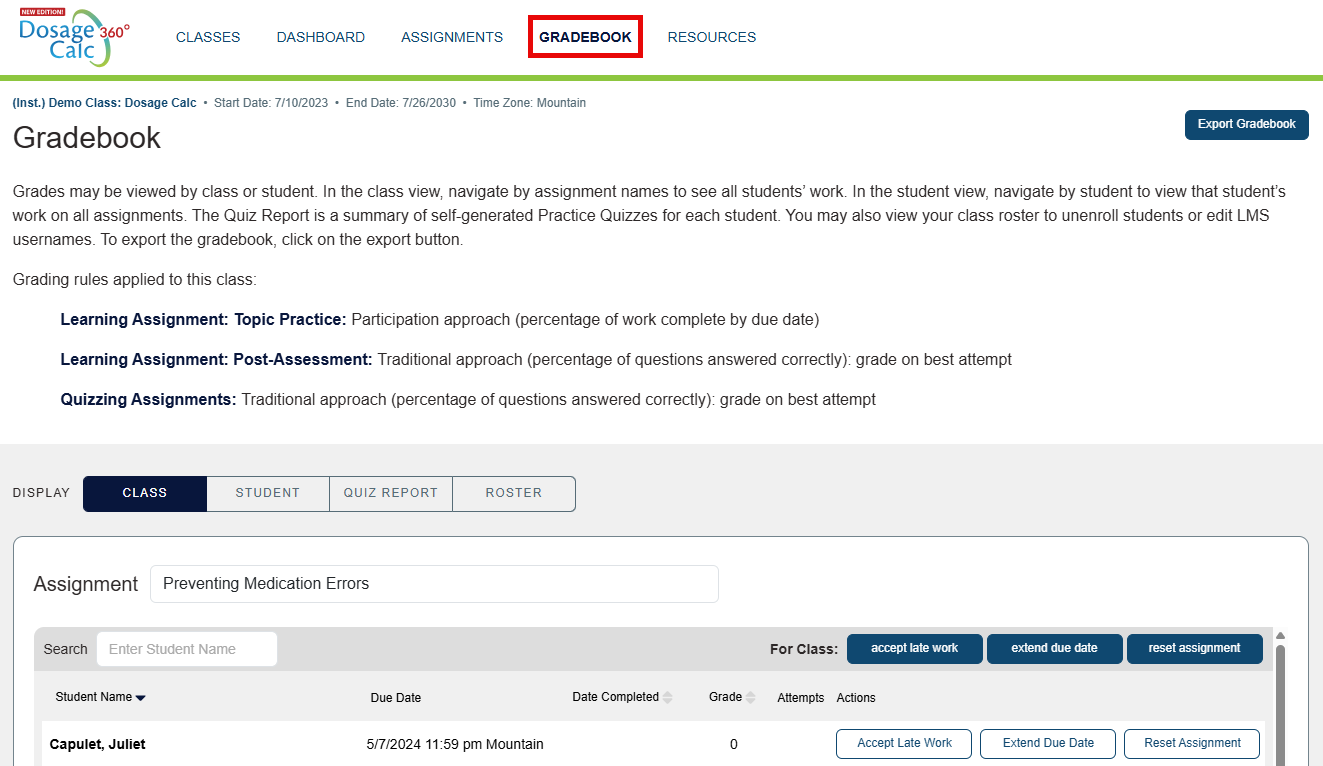
To check how your students are being scored for credit, and to accept late work or extend due dates, navigate to your Davis 360 class' Gradebook page. If you need more information on how to use your Davis 360 Gradebook, please consult the "Grading" and "Davis 360 Gradebook Features" sections of our "Grading and Metrics" article for instructors.
7. Access your Instructor Resources
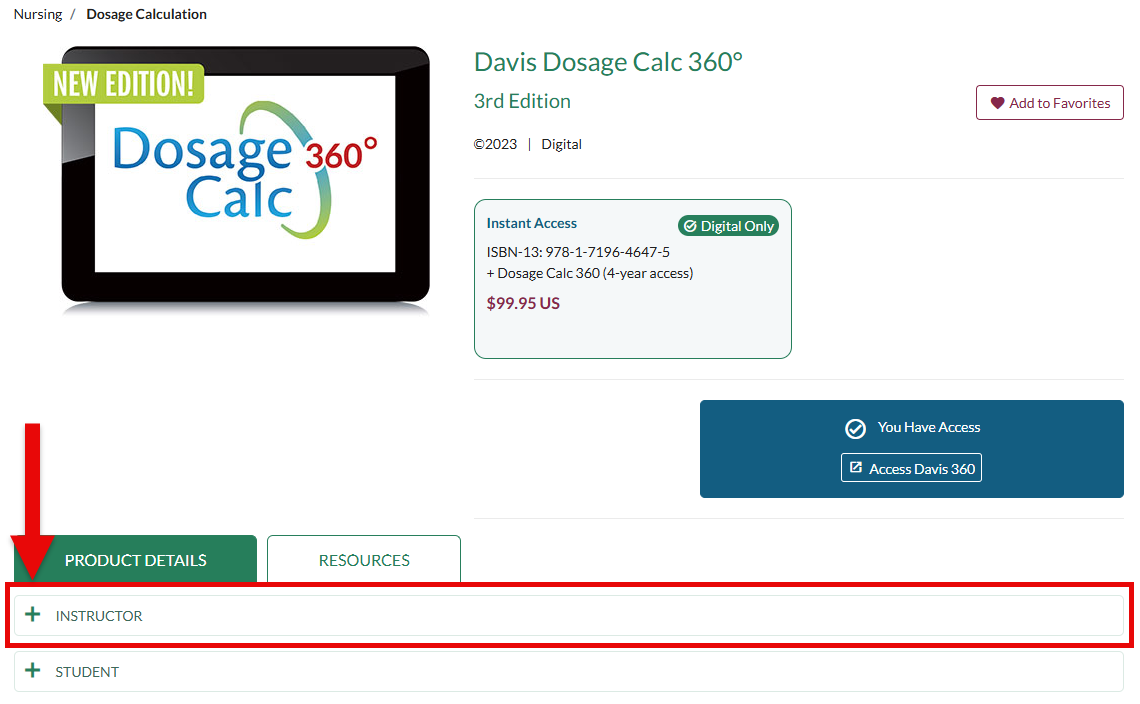
For guidance on accessing your Instructor Resources, which include pre-made PowerPoint Presentations and test banks, please consult our "Instructor Resources" article.
8. Distribute the student Quick-Start Guide
If your admin hasn't already, please link the student "Quick-start Guide" article to be seen early in your LMS course content or in your syllabus. The student Quick-start Guide is designed to be an asynchronous orientation of all students need to know to launch and complete assignments within Davis 360, as well as how they can best utilize additional resources offered by Davis 360.
Students should enroll in your integrated Davis 360 class by launching a Davis 360 class link via your LMS course. You can direct your students to log into FADavis.com and navigate manually to Davis 360, so they can then enroll themselves in your integrated Davis 360 class using the Class ID you provide them, but enrolling students that way will add unnecessary steps to the student enrollment process.
After enrolling in your integrated Davis 360 class, students have the option to log into FADavis.com and navigate to your Advantage class manually, but we recommend they continue accessing your integrated Davis 360 class via launching your inserted class links.
To confirm all your students are within your Davis 360 Advantage class, click the "Roster" display within your Davis 360 Gradebook. Please confirm your Davis 360 class roster a few days after your class start date, to ensure all your students have enrolled correctly.
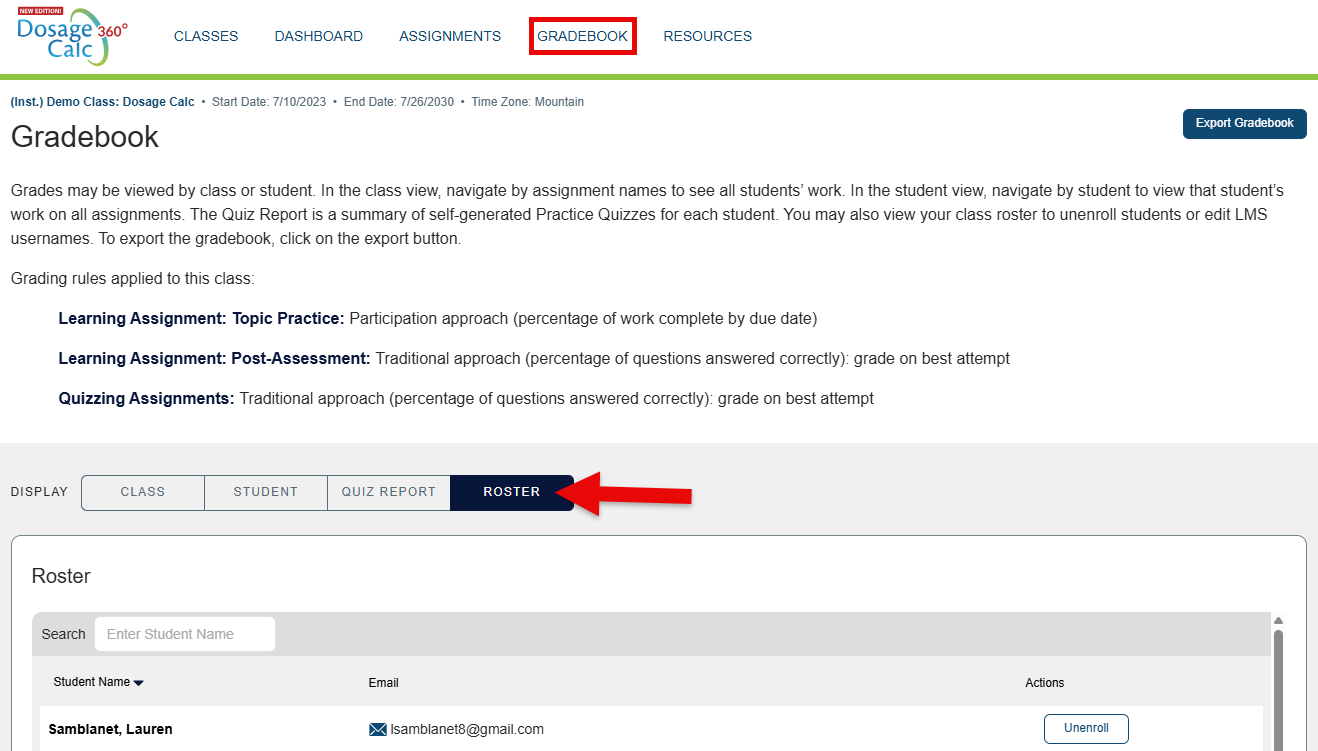
If a student’s grades do not appear in your Davis 360 Gradebook, they may be completing work independently and/or under an email account that is not enrolled in your course. You can check this by asking the student to confirm which email account they are using to access Davis 360. If the student has completed work under a different email, you can direct them to contact Customer Care via [email protected] for assistance merging their two accounts.
For more information on why a student might not be on your Davis 360 class roster, consult our "Enrollment Issues" support article.
9. Need more help?
If you have consulted the information/resources above and are still unable to access your Davis 360 content, please contact us via [email protected]. Include your name, LMS login email address, and the name of your institution in your email to us, so our team can contact and assist you.
Additionally, if you have further questions about your integrated Davis 360 class, please consult our Instructor "FAQs" article.

